

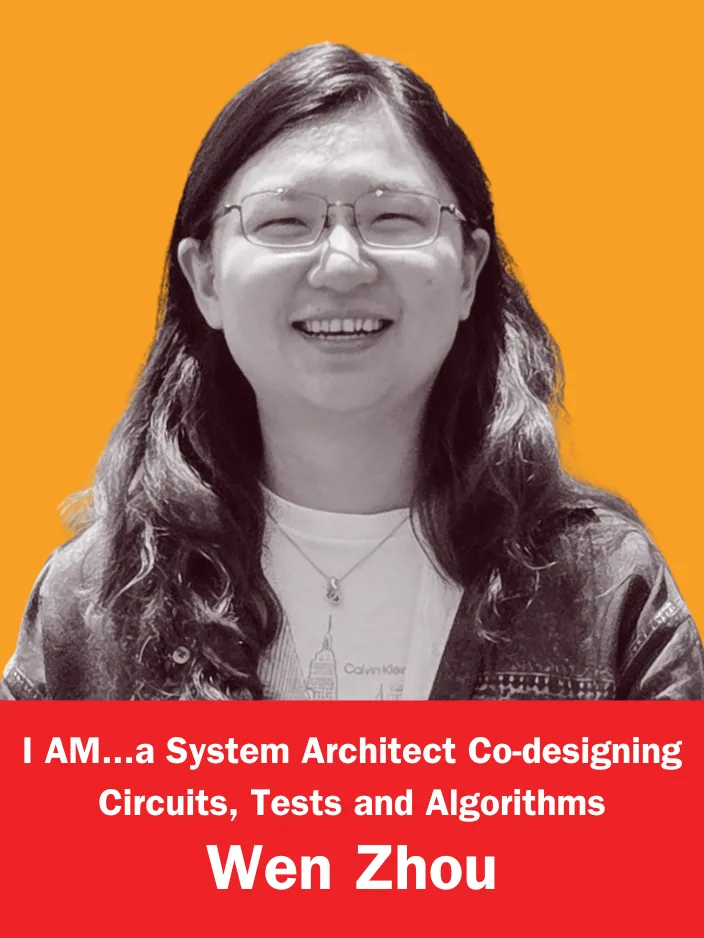
Dr. Wen Zhou, Senior RF System Architect, Advanced Circuits and Systems Lab, Samsung Semiconductor
I AM...a System Architect Co-designing Circuits, Tests and Algorithms
What made you want to work in this industry?
The first electronic device I built was a water-pump control system in high school that automatically adjusted the water level in a fish tank. I enjoyed the process of building something from the ground up. In college, I turned this interest into a career direction and chose Instrumentation and Control Engineering as my major. Alongside my coursework, I built an automated thermal conductivity test system for the Physics laboratory during my freshman and sophomore years. Later, during my junior and senior years, I developed a wireless temperature sensing system based on a surface acoustic wave resonator. This project naturally led me toward microwave engineering, RF sensing, and circuit design.
At the University of Minnesota, my M.S. and Ph.D. projects further shaped my technical path. During my M.S., I hacked a vector network analyzer and repurposed it to characterize the RF properties of magnetic nanowires, and then used the nanowires and the VNA to build a cancer-cell biolabeling system. During my Ph.D., I built an E-band digital radar SoC with analog correlators for high precision sensing and demonstrated the integrated radar system performance in the bistatic setting. These project gave me the opportunity to work across circuits, systems, software and applications. The cross-disciplinary nature of these projects make the industry fascinating to me.
What is your favorite part of your job?
My favorite part of the job is working on problems that connect real application needs with deep technical challenges. I enjoy the process learning what a system must achieve, breaking the needs down into technical requirements, identifying and addressing the key bottlenecks, and working with different teams to co-optimize sub-blocks for the best system performance. I have been fortunate that all the projects I have worked on required this end-to-end mindset. What I find most rewarding is navigating the design trade-off space at the technical domain boundaries. Now I work in a larger design team where my role includes both pre-silicon architecture definition and post-silicon system integration. It is an interesting and challenging role that uses all my past experience and skills and also pushes me to keep learning.
What were you most excited about for IMS2026?
I was and continue to be excited to see IMS shift its focus toward system-level innovation and real-world impact. I have attended IMS/RFIC regularly and see it as an important venue to follow industry and research trends, reconnect with the community, and learn about emerging technical directions. I am also excited to be involved in organizing Project Connect and to support the growth of young engineers.