

New for IMS2026! The RF Systems Pavilion featuring live systems demonstrations for radar and communications. Join us in booth 20088!
Demonstration #1: Radar
Beyond the Datasheet: System-Level RF Insight with Digital Twins
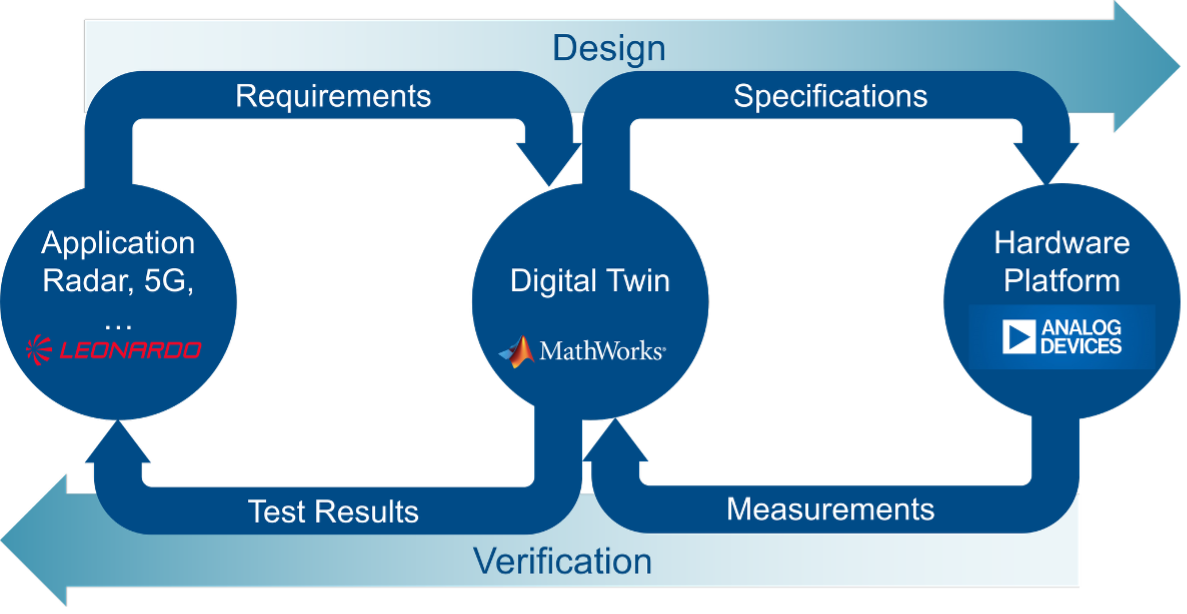
Reaching a complete and confident RF system design solution remains a slow, manual, and iterative process for many engineers. Traditional approaches—analyzing product datasheets, performing isolated small-signal simulations, or relying on repeated rounds of lab prototyping—often lack the system-level insight needed to understand true performance in real-world conditions. As RF architectures grow more complex and mission profiles become more demanding, the need for clear, application-specific design visibility has never been greater.
Digital twins offer a path to design clarity. Unlike standalone simulations of individual components, digital twins evaluate system-level behavior for specific applications and use cases. Analog Devices’ digital twin models are virtual representations of ADI RF components and ICs, developed natively in the MATLAB and Simulink environment. This environment enables full-system performance evaluation early in the design process, allowing engineers to explore architectures, assess trade-offs, identify risks, and accelerate decision-making before committing to hardware. Beyond modeling and simulation, digital twins establish a digital thread that supports design and verification, connecting requirements, design decisions, measurements, and results throughout the supply chain, thereby enabling rapid and unambiguous communication between component manufacturers and system integrators.
For IMS2026, the RF Systems Pavilion demo highlights how companies leverage ADI digital twin models within MATLAB and Simulink to simulate their applications. This includes a demo from Leonardo UK showcasing how they simulate a radar system’s probability-of-detection performance. Their workflow demonstrates how digital twins enable mission-level evaluation—translating component-level behavior into meaningful system outcomes. Attendees will be able to view simulation videos running continuously throughout the three-day event and engage directly with staff from Analog Devices, MathWorks, and Leonardo to discuss model construction techniques, model fidelity, simulation capabilities, and application-specific insights. In addition to the looped content, a live demo session will be held once per day to support deeper technical interaction for larger audiences.
Demonstration #2: Communications:
A Lunar Surface Communications Testbed: Validate Lunar RF Systems—Before You Launch
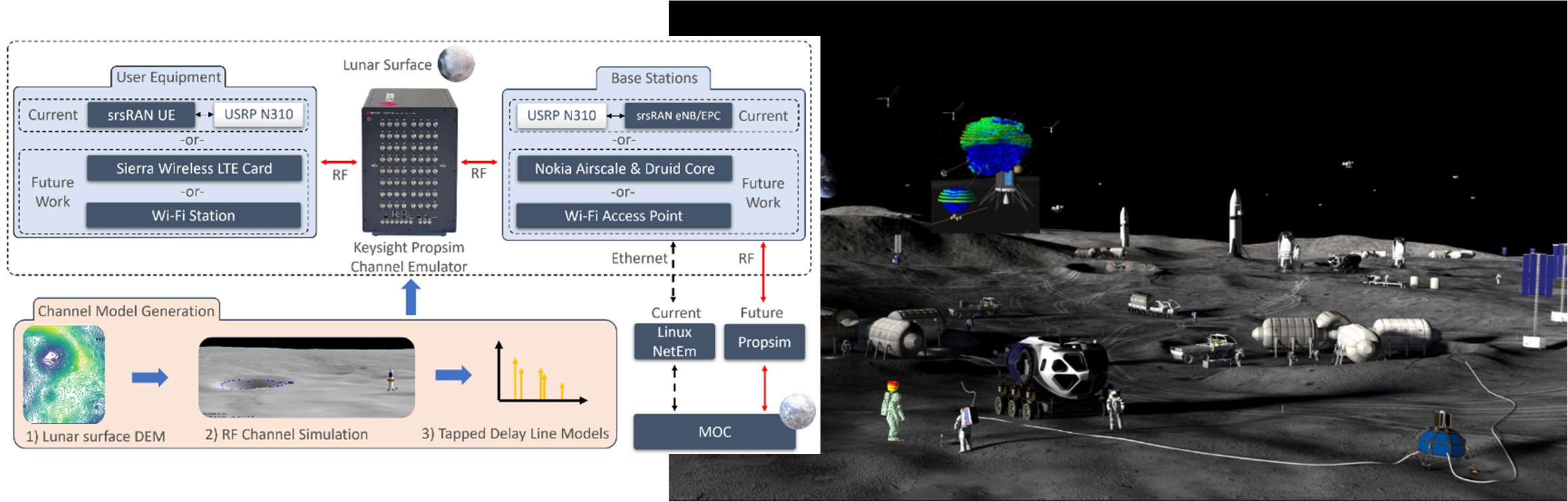
As NASA’s Artemis program establishes a sustained human presence on the Moon, reliable surface communications are mission-critical. While technologies like Wi-Fi and 3GPP (4G/5G) are proven on Earth, the lunar RF environment is harsher, unfamiliar, and impossible to fully field-test ahead of time. This demo features the NASA Glenn Research Center Emulation and Modeling (GEM) Testbed—a hardware-in-the-loop RF validation platform that brings realistic lunar surface communications testing into the lab.
What This Demonstration Shows:
The GEM Testbed enables engineers and mission planners to predict and validate end-to-end communications performance for lunar surface operations using:
- Physics-based RF channel modeling and ray tracing
- High-fidelity lunar digital terrain environments
- Commercial hardware RF channel emulation
- Real 3GPP and Wi-Fi radios and network stacks
The result: real hardware operating over realistic lunar surface RF channels—without field testing or flight risk.
Reduce risk. Save cost. Move faster.
- Eliminate early lunar field trials. Replace expensive analog testing with repeatable, lab-based validation.
- Predict real lunar performance. Evaluate coverage, throughput, latency, shadowing, and multipath elects.
- Accelerate system design. Rapidly swap radios, stacks, and configurations—COTS or research-grade.
- Enable smarter mission planning. Analyze EVAs, surface traverses, landing sites, and network layouts before deployment.
Built for Lunar Surface Missions, but applicable to any terrestrial setting
- Site-specific lunar terrain and RF propagation
- Hardware-in-the-loop realism—not simulation only
- Designed for surface-to-surface lunar communications
- Scalable from early demos to future lunar infrastructure
A Collaborative Effort
This demonstrator is a collaboration between:
- NASA Glenn Research Center – Lunar communications research and system validation
- Ansys (part of Synopsys) – High-fidelity RF and digital mission modeling
- Keysight Technologies – Hardware RF channel emulation and measurement
Together, they deliver an end-to-end digital-to-hardware workflow for validating wireless systems in extreme lunar environments.